
Jump to:
Competency Area
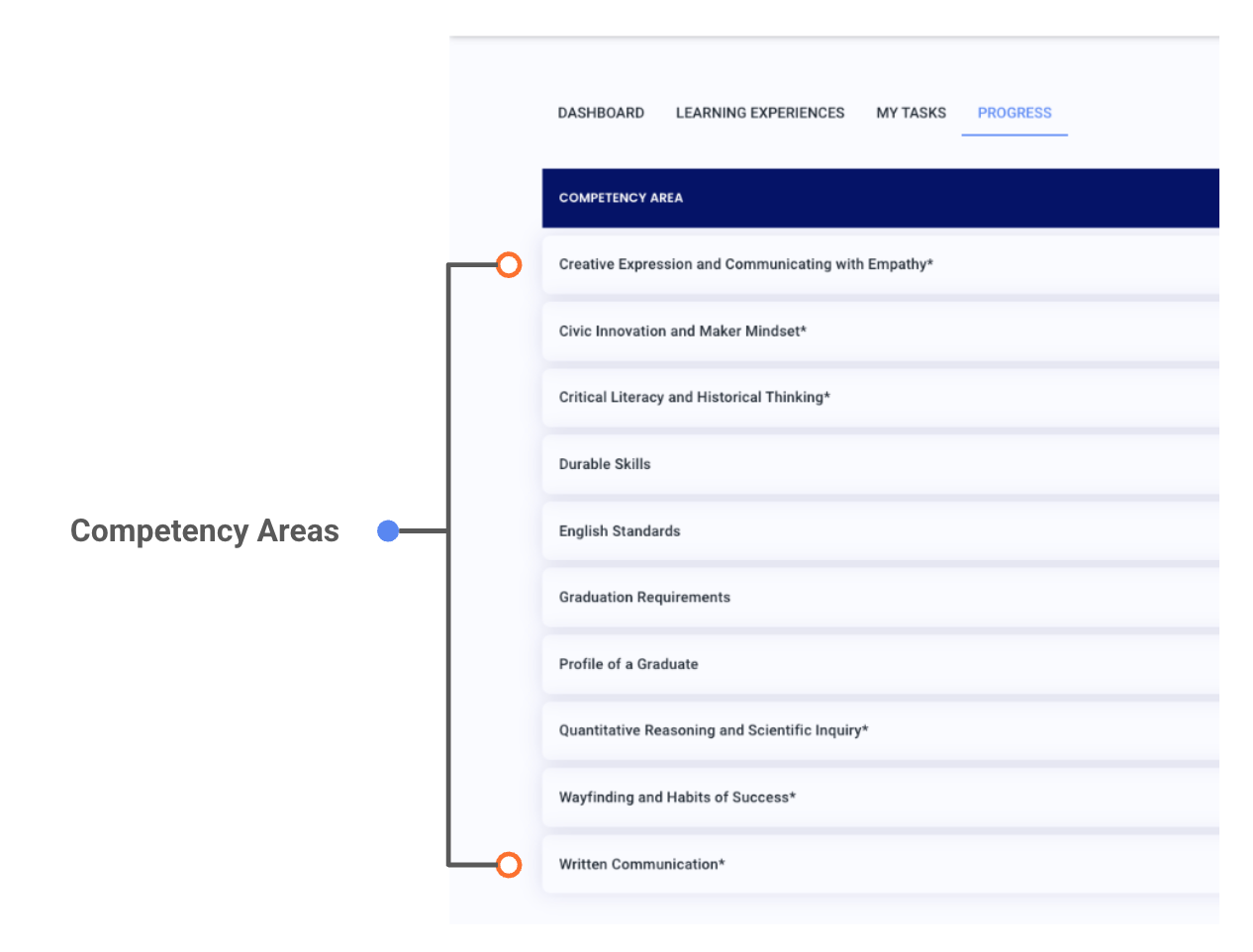
A competency area is a broad topic or subject, like Creative Expression and Communicating with Empathy. The competency areas a learner is working on appear on the Progress page. In Beacon, standards are also referred to as competencies, so both are included as competency areas.
Competency
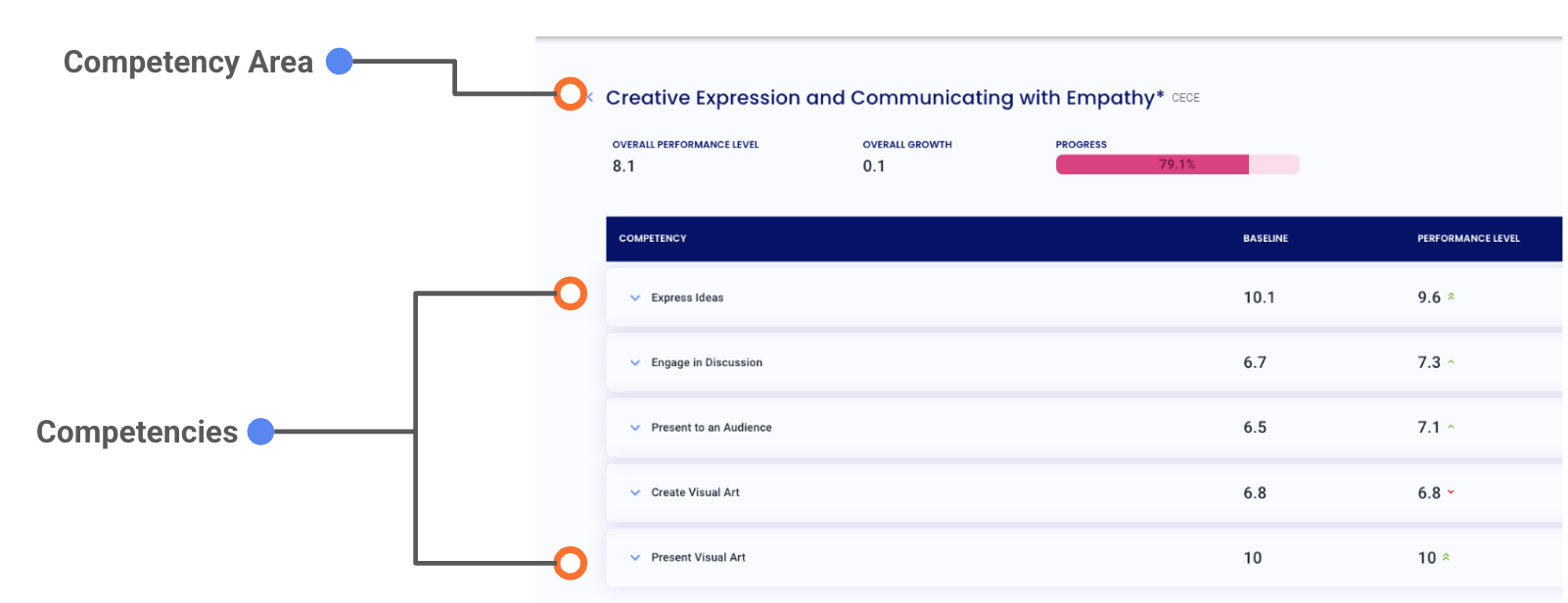
A competency explains what learners should know and be able to do within a competency area. For example, Express Ideas is a competency within Creative Expression and Communicating with Empathy. You can view a learner’s competencies by selecting a competency area on the Progress page.
Here are the competencies for Creative Expression and Communicating with Empathy:
Skills
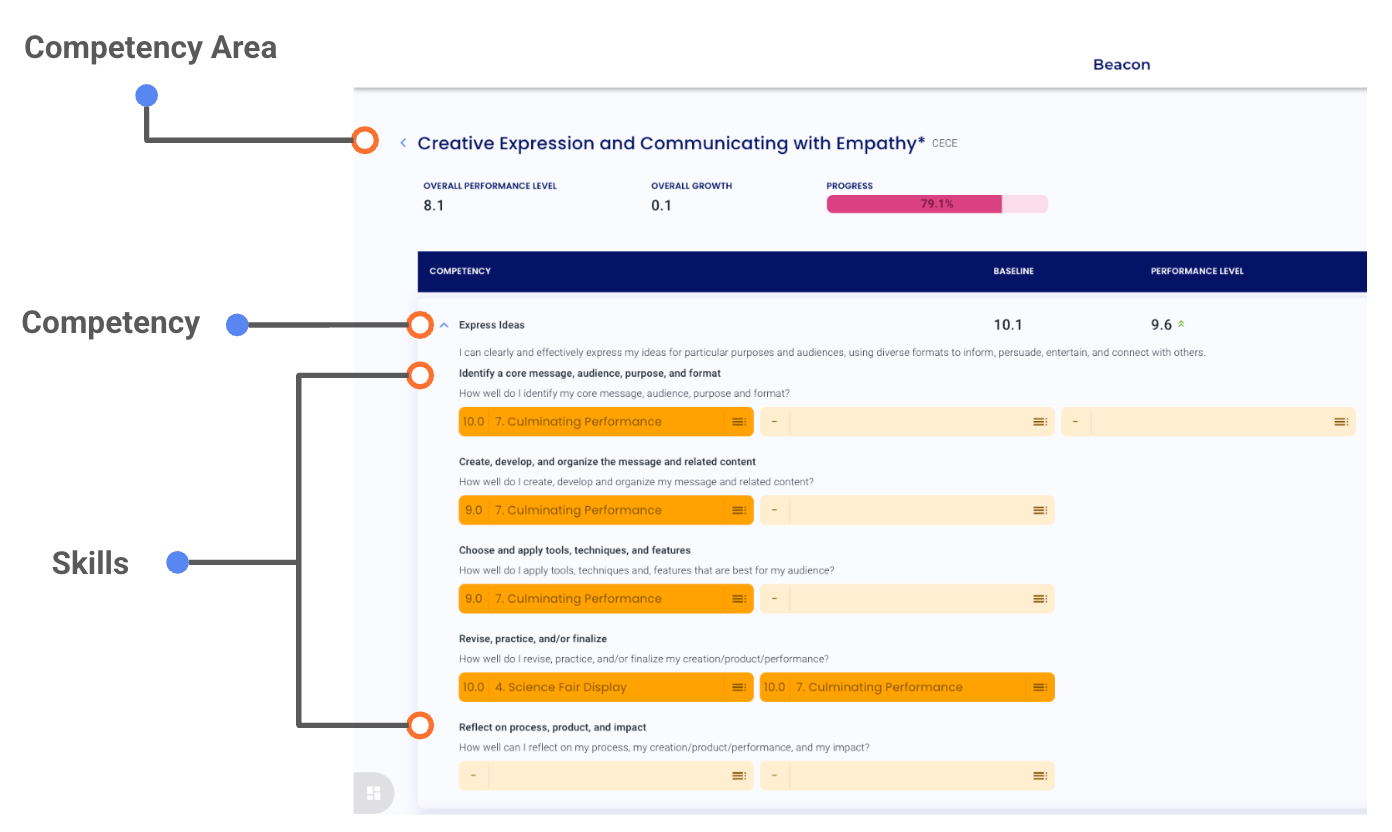
Skills describe the specific abilities or behaviors learners practice to show their progress in a competency. Identify a core message, audience, purpose, and format is a skill of Express Ideas.
Here are the skills for Express Ideas:
Evidence Requirements
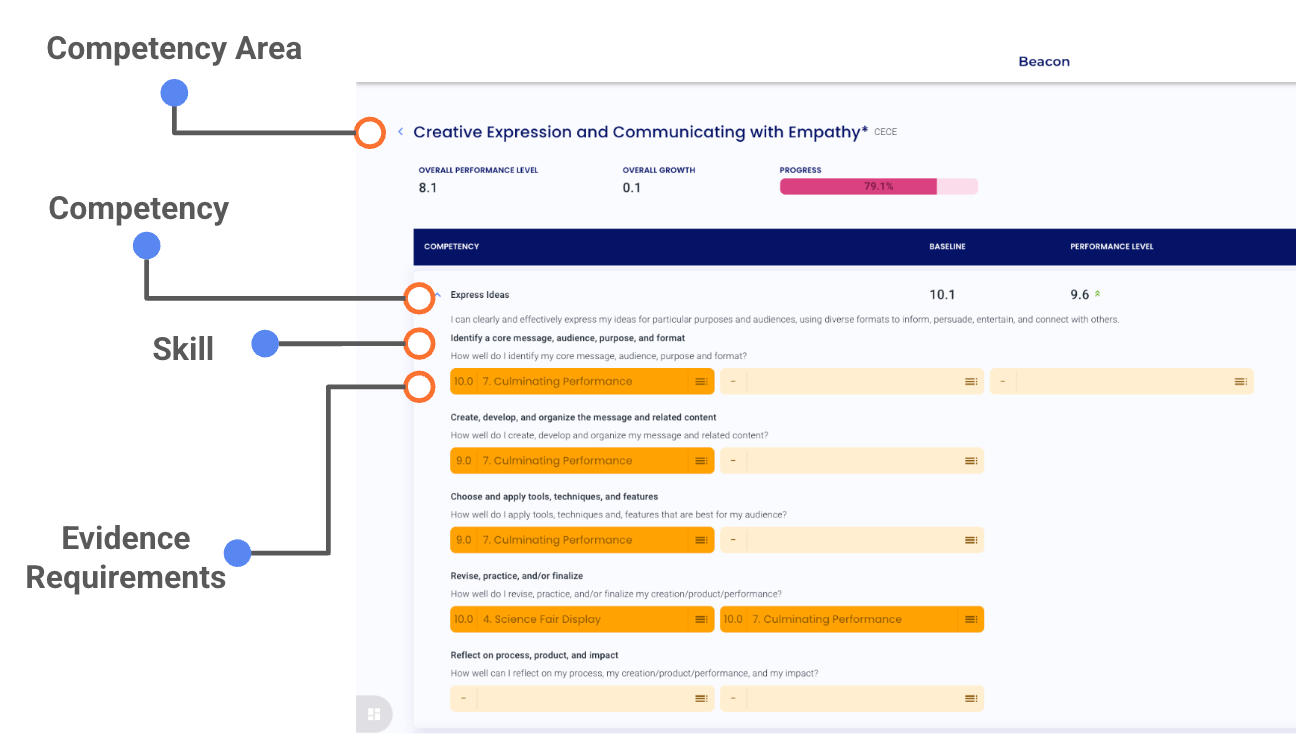
Evidence requirements show how many times learners need to demonstrate mastery or growth of a skill. Each school decides the number of requirements for each skill in each portfolio. You can see the requirements as boxes listed under a skill.
For example, the skill Identify a core message, audience, purpose, and format has three evidence requirements, while Create, develop, and organize the message and related content has two. Learners submit different types of evidence of their learning, which are then rated.
Rating
A rating shows how a learner did on the work they submitted. In a traditional system, this would be similar to a grade. Some ratings use a numerical scale that shows how a learner's performance grows over time. Others may use simple options like 'met' or 'not yet,' a checklist, or levels such as 'approaching,' 'proficient,' or 'mastery.' Ratings are used to calculate baselines, performance levels, and progress. Some ratings may be marked as potential progress only, meaning they do not count toward progress completion but will appear on the progress bar to show where a learner could be if the rating improves or is replaced.
Baseline
A baseline for a competency is calculated once each skill has been rated one time or when 50% of the total evidence requirements have been rated in that competency, regardless of which skill. Baselines are used to calculate growth over time. When a learner moves into the next portfolio, their previous performance level becomes the baseline for the current portfolio.
Performance Level
Performance levels in a competency are calculated by averaging the skill ratings within that competency. When more evidence exists than required, Beacon uses the highest ratings in that calculation. A performance level for a competency area is the average of all competency performance levels in that area. These performance levels, along with overall progress, are used to determine whether a learner has completed a portfolio.
Growth
Growth in a competency shows how a learner's performance has changed from their baseline to where they are now. A baseline is a calculated starting point — not simply the first rating given. This growth can go up or down. Positive growth means the learner is improving, while negative growth means their performance has decreased compared to their baseline. Growth is also calculated at the competency area level by averaging growth across all competencies in that area.
Progress Bar
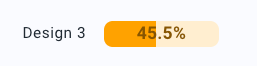
The progress bar shows how many evidence requirements have been rated compared to the total number a learner needs to complete. For example, this learner is 45.5% through the Design 3 portfolio. The percentage only reflects progress and does not reflect performance level. If any ratings are marked as potential progress only, they will appear as a separate indicator on the progress bar, showing where a learner could be if those ratings improve or are replaced.
Portfolio
A portfolio is a collection of competencies and skills where learners show what they know by submitting evidence of their work. A portfolio is considered complete once all evidence requirements are finished and the learner has met the expected performance level and/or growth. Some competency areas have multiple portfolios that learners progress through, while others have just one. Portfolios are color-coded so it’s easy to see a learner’s progress in Beacon. Current portfolios can be viewed on the Progress page, and each competency area will have its own portfolio of competencies and skills.
Continua
A continua shows how a skill grows from a beginning level to a more advanced one. It’s sometimes called a progression. Each skill within a competency has its own progression that describes the stages of learning and what a learner’s work looks like at each stage.
Indicators
Indicators describe what a learner’s work should look like at each stage or level. Any bolded words show what is new or different from the previous stage.
Here is an example of the continua for the skill Use evidence to develop claims and counterclaims, which is under the competency Compose Evidence-based Arguments under the area ELA.
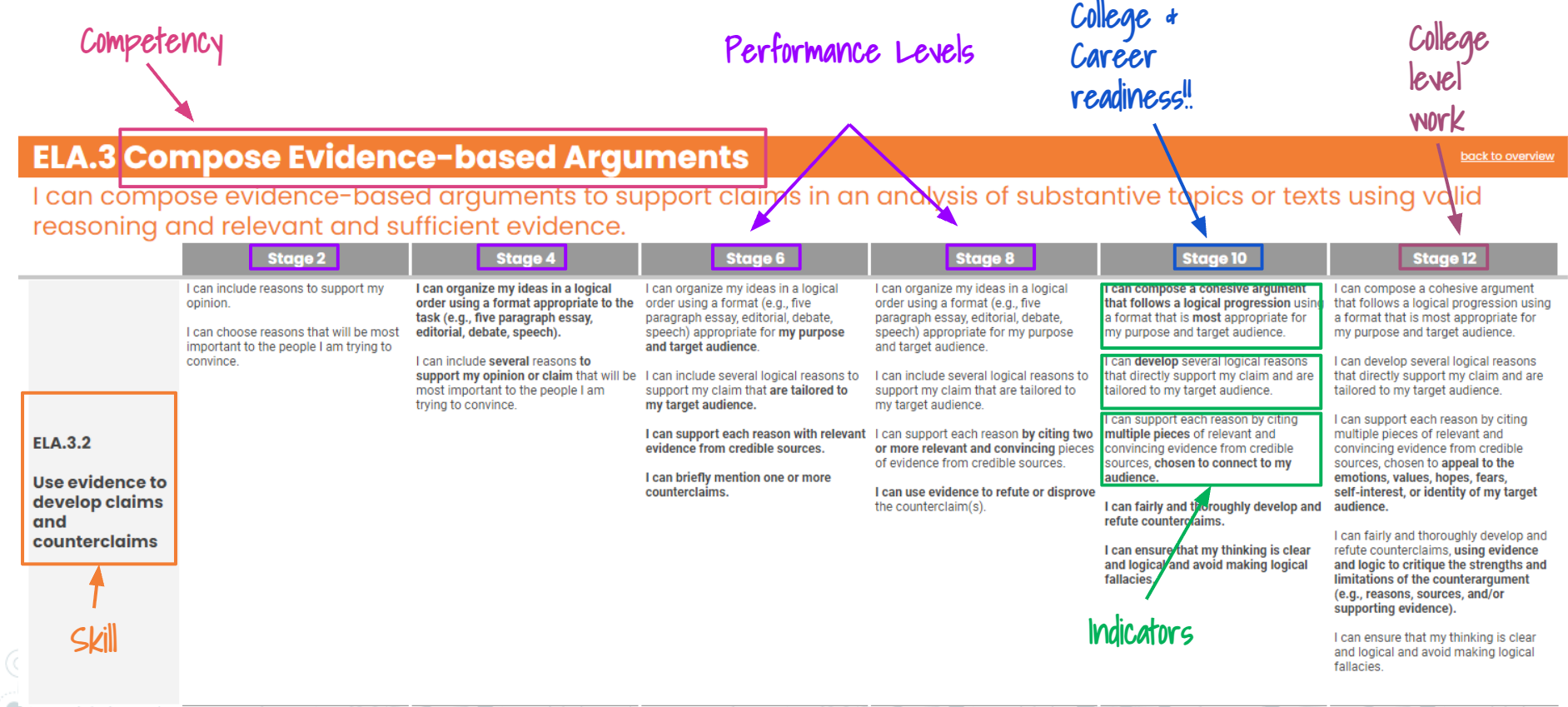
When a learner submits evidence for feedback, the continua is used to rate that evidence*.
*Standards will typically have a different rating scale than competencies.